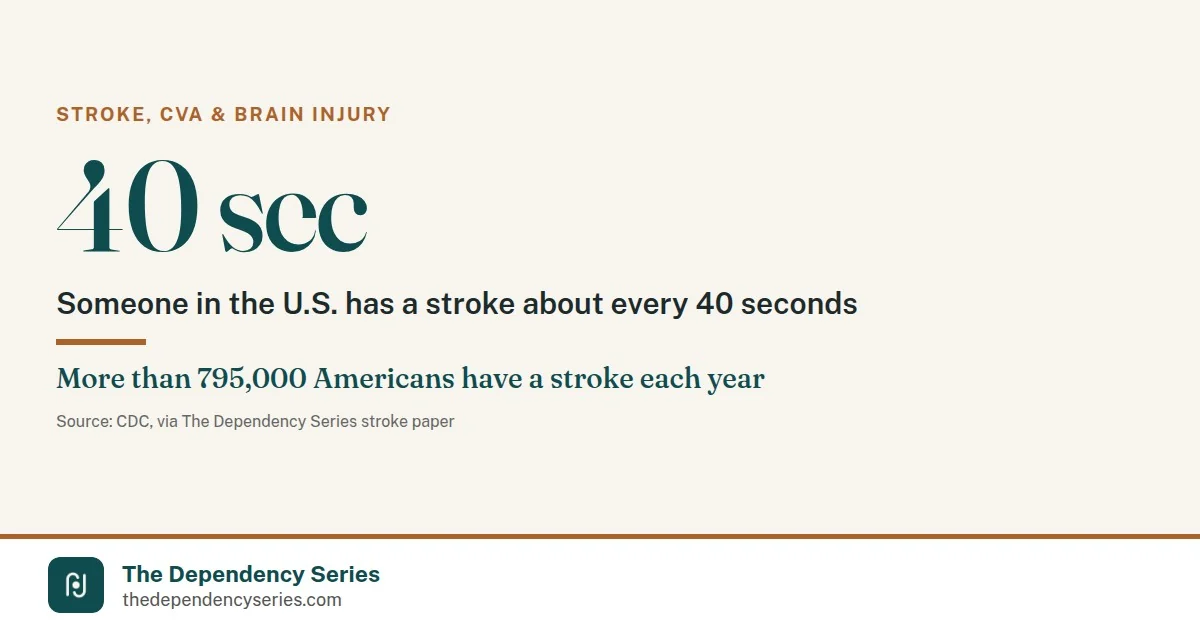
- More than 795,000 Americans have a stroke each year, about one every 40 seconds (CDC).
- Stroke reduces mobility in more than half of survivors age 65 and older.
- Medicare covers the hospital, inpatient rehab and up to 100 days of skilled nursing after a qualifying stay, but not ongoing custodial care (Medicare.gov).
- The months of help with bathing, dressing and walking afterward are often the largest cost for families.
Why stroke is different
Stroke is the fifth leading cause of death in the United States and a leading cause of serious long-term disability (CDC). It reduces mobility in more than half of survivors age 65 and older. More than half have thinking or memory problems in the first year, and about one-third develop depression. Recovery is fastest in the first three to six months, but meaningful gains can continue for years.
That combination, sudden onset followed by a long and uncertain recovery, is what makes stroke so hard to plan for after the fact.
What Medicare pays for
In the first weeks, Medicare usually covers most of the medical care:
- Hospital and inpatient rehab: covered under Part A. In 2026, days 1 to 60 cost $0 after the $1,736 deductible, and days 61 to 90 cost $434 a day.
- Skilled nursing: up to 100 days in a skilled nursing facility after a qualifying three-day inpatient hospital stay, with a daily coinsurance of $217 for days 21 to 100 (Medicare.gov).
- Home health and outpatient therapy: covered when a doctor orders skilled care and the person meets Medicare’s rules.
Where coverage stops
Medicare doesn’t pay for long-term custodial care, the help with bathing, dressing, eating, using the bathroom and moving around that many survivors need after therapy ends (Medicare.gov). It also stops paying for skilled nursing when the person no longer needs daily skilled care, even if 100 days haven’t passed.
For many families, that is the largest cost of a stroke: not the hospital stay, but months or years of help at home, in assisted living or in a nursing home.
Questions to ask in the first weeks
- Inpatient rehab or skilled nursing? Inpatient rehab provides about three hours of therapy a day. Ask the hospital team which setting the person qualifies for and why.
- Who will help at home after discharge, and for how many hours a day?
- What home changes are needed? Grab bars, a shower chair and clearing walking paths can prevent a fall.
- Are legal documents in place? A durable power of attorney and a health care proxy let a trusted person act if the survivor can’t.
- How will ongoing care be paid for? Long-term care insurance, VA benefits, savings and Medicaid each have different rules. Our sister site FundingDependency.com explains the options.
Preventing a second stroke
Nearly 1 in 4 strokes happens to someone who has already had one. Controlling blood pressure, treating atrial fibrillation, taking prescribed medicines and staying active all lower the risk. About 80% of strokes are considered preventable.
The free Stroke, CVA and TBI white paper covers stroke types, warning signs, rehabilitation, Medicare and planning in more depth.
This article is educational information only, not medical advice.
Common Questions
Does Medicare pay for care after a stroke?
Medicare covers hospital care, inpatient rehabilitation, up to 100 days of skilled nursing after a qualifying hospital stay, and home health and outpatient therapy when the rules are met. It doesn’t pay for ongoing custodial care such as help with bathing and dressing.
How long does stroke recovery take?
Recovery is usually fastest in the first three to six months, when the brain is most able to rewire itself, but meaningful gains can continue for years.
What is the difference between inpatient rehab and skilled nursing after a stroke?
Inpatient rehabilitation provides intensive therapy, about three hours a day, for people who can take part. Skilled nursing facilities provide nursing care and less intensive therapy.
Can you prevent a second stroke?
Many second strokes can be prevented by controlling blood pressure, treating atrial fibrillation, taking prescribed medicines and staying active. Nearly 1 in 4 strokes happens to someone who has already had one.
Topics in This Post
Educational content only, not medical, legal or financial advice. Talk with a qualified clinician about your own situation. Sources for this post (all accessed October 2026):
Comments and Discussion
Loading comments...
Comments are moderated. By posting you acknowledge our Terms of Use, including the educational-content disclaimer, AI research disclosure, and hold harmless acknowledgement.